Monday, February 3, 2025

Fun and Games


I know there comes a time in life where we ask ourselves, "why do I do what I do? Am I finding joy? Am I changing the world to be a better place? Am I doing enough? How do I feel about what I've done thus far? Am I a success?"

I was born asking these questions to myself. I hate expectations, especially my own.  

A dear friend recently asked me:  "Barbara, what did you expect to get from writing your book"?  My reply?  "Nothing.  I did it because I had to".  

I have no remaining family.  I left my influences and contacts in NYC when I moved upstate in 2000.  Now I live in the middle of the woods with my two cats Teddy and Bear.

 I have a peaceful life and am so grateful I can make a living doing what I love.  But I've paid my dues and have stories that no one has known until now.  Stories that speak of "lessons learned".  I wish I'd had a book like this to read when I graduated art school and wanted to move to NYC from Cleveland in 1979. 

This book started 10 years ago in my mind.  The last 3 years were spent actually writing it.  It was a labor of love and since the publishing industry is such a rat race, I decided I didn't have much time to wait at the age of 70, so I better just publish it myself. And I did.

Even though the world of jewelry has changed significantly since 1979,  I was hoping that young creatives would find it interesting and cautionary.  I also wanted to have my clients and rumored "cult following" know more about my life. Perhaps it would be a good book for art school libraries!

It's interesting, though, that since writing this book and sending it out (often for free) to friends and 
"influencers" I've learned that you can write a book, but getting it to be seen or read is not a given.  Since writing and publishing my book, I've seen other jewelers writing their biographies and memoirs.  Is this a trend?  Art Smith never wrote a book and neither did Sam Kramer. I wish they had.  I miss the days when I could call up a magazine editor and give a pitch and they would respond.  I have friends who are writers, gemologists, jewelry devotes, and jewelry influencers.  I've always been one to reach behind me on the ladder to grab the hand of those behind me. I like to share and connect people.  But that is NOT a universal consideration. I mean, how many times can you DM or email a person to ask if they've read the book you sent them?  Please LMK. I was so surprised to find that a particular jewelry IG influencer had their account restricted to a "one-time" DM and they would get back to me "once I was approved".   

Here's a really funny youtube video with Penny Arcade from 

 Truth!


 But some friends have also been incredibly generous: Note this article by Bob Krasner for AM/NY.


Here, also, is a book mention from 
Elyse Karlin, "Adornment Magazine". 


Basically what I've learned is that the only reason to do something is because you have to. And, oh yeah, success today is not what I imagined it would be in 1979. It's better.

LET THE GAMES BEGIN!


Wednesday, May 17, 2023

Why I make Reliquaries


I saw my first reliquary at the Cleveland Museum of Art while I was majoring in metalsmithing at the Cleveland Institute of Art.  I was not raised Catholic, but it seems that Catholicism, Buddhism, and many other religions had made numerous and impressive tributes to their Gods and Saints since the beginning of time.  Perhaps in Pagan times, these were talismans.  They became something to physically embrace in eternal remembrance.  This had a huge impact on me because it seems like I've always wanted to hold onto something that helped me understand the meaning of life through loss.


I've lived through the Aids crisis, the Cancer crisis, and most recently the Covid Crisis.  I am profoundly impacted by death and loss.  It has not left me unmarked.  Making something as a memorial or tribute to these losses gives me peace.

In the interim between birth and death, there s life.  In life, there are things we hold onto as memories and mementos.  It's a fact that we're born alone and die alone.  That is why I'm fascinated by the objects we hold dear to our hearts, the things, and memories we collect to ease the pain and celebrate the joy during our life journey.

What can be more special and tender than a memorial to those we've loved and lost or to the things we've held close to our hearts as talismans.  This is where my "act of art" becomes an "act of the heart".  In making these pieces it becomes prescient and relevant in these trying times now more than ever.

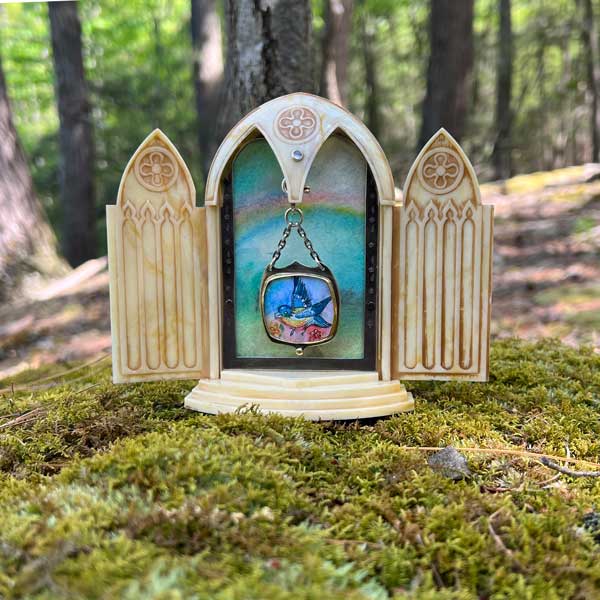
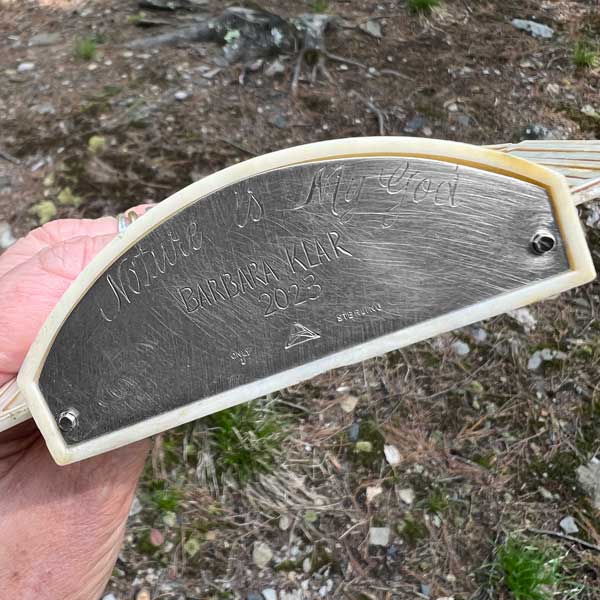
In my most recent reliquary, I explore God.  What is God?  To me, Nature is my God.  It is something that regenerates and dies and completes the process regularly.  Regeneration. Joy. Peace.  Things we all seek.  This Reliquary is made from an antique celluloid rosary case.  I made a watercolor inside that shows a rainbow at the end of the path,  I painted a small bluebird to represent the hope of flight and transformation.  I would love to be able to fly.  This little bird painting is encased in a gold bezel and set under an old watch crystal and can be removed from the hook to be worn on a necklace, close to a beating heart.


Tuesday, January 24, 2023

Historical Inspiration and my obsession with Mansions


I love houses, especially old houses. And even more, I love mansions. The older the better I guess you could say;  they were a foundation of my youth even though I was struck strictly lower middle class.  Unity was the religion I practiced and it took place in the old Seiberling mansion in Akron, Ohio. The Seiberlings were the founders of Goodyear, where my father worked. This old mansion had been built when the company was first established.

A reformed Catholic, my mother discovered Unity when I was five.  Unity is a religion based in metaphysics and it was housed in an old mansion.   Unity had bought a huge Tudor Home and Coach house from one of the rubber magnates when Akron was experiencing a deep decline and the suburbs were booming.  Unity was primarily an adult congregation of misfits and mystics.  Void of other children, I would roam this mansion unsupervised.  I would run my hands over the weathered mahogany banisters and the brass hinges as I searched for ghosts in the fur closets.  I discovered two wall safes and learned to hear the clicking of the gears as I put my ear to the metal and tried to crack them open.  There were dumb waiters and secret staircases.  The bathrooms were enormous and stunning with glistening tiles and vintage porcelain.  There were carvings in stone and brass hardware adorned fine cabinetry.  In the basement, there was a second kitchen used for events with original stoves and sinks.  Down a few steps was a larger room that had been used as a small theatre with a rotating stage.  There was a fourth-floor ballroom full of gabled windows with nooks where a small child could curl up reading a book.  A butler’s quarters next to the ballroom had the smell of old books and incense.  Amber lighting illuminated this mysterious library with carved mahogany woodwork. 


As I roamed these hallways with fascination, I imagined the workers who created this masterpiece of architecture and design.  Who were they?  Where were they? How did they make this?


Not only did my curiosity become inspired, but I learned to meditate. Unity installed a bio-feedback machine where we learned to take the power of the mind over the body.  We studied the Bible yet not in a literal way.  At 7 years old I was smacked in the face on the playground by another child when I announced  “Jesus was not real”.  He was only written to convey “the ideal human” in a book of fiction.


I am expanding here because I want to emphasize how important it is to follow the signs on a path.  The journey is the meaning.  I may have developed a love of craft in this mansion but it was my ability to learn to control my mind through meditation that stabilized me on the journey for which I was never fully prepared. My journey forward resembled falling off a cliff without a parachute.  As a child, I had nightly dreams of falling over a cliff as it wrenched me from the depths of sleep into a panicked, sweaty fear.  I learned to combat this when I trained myself to imagine gently falling into a pile of hay when I fell off that cliff in my twilight travels.  The dreams stopped. Fear, however, did not.  It never does.


Some drawer pulls of my own design, below:


Thursday, March 11, 2021

The Broken Plate


The most meaningful part of my journey
as a jeweler and metalsmith are the pieces I make that reflect a period in time that represent someone else's journey.  These are pieces that incorporate history, memories, and emotions.  These opportunities are the gift of my work and I am constantly amazed what I learn about people and what I am blessed to creatively express.

When my friend Cherie approached me about making a brooch from a broken plate, I had no idea about the backstory of this broken plate.  Here is her story:


BLUE CHINTZ by Cheri Banks

Born to Swedish immigrants in 1897 Cecelia Louise Samuelson's life spanned a period marked by tragedy and triumph; from a childhood train accident that nearly severed her legs to financial ruin after the stock market crash of 1929 and her husband subsequent struggle with alcoholism (and courageous recovery) and Cecilia ran two small businesses to help make ends meet while fighting a recurrent battle with cancer that took both of her breasts. She narrowly escaped a devastating house fire in 1968 and lived to see a man walk on the moon. She lost her last battle with cancer in 1972.

Celia, my grandmother, was the strongest woman I've ever known. I adored her.

In the early 1920s, Cecelia and Arthur were newlyweds strolling through a giant New York town when a shop window displayed a vibrant English transfer-ware dishes caught Cecilia's eye. Wavy-edged squared plates in Crowned Ducal's "blue chince" pattern featured a bright blue background covered with tropical birds, flowers, branches and foliage. Arthur took note and secretly returned to the shop to buy the luncheon set for her.

After Cecilia passed away, my mother gave the set to me and I displayed the plates on a wall in my home. When one accidentally fell to the floor my heart shattered too. I gathered the plate fragments and kept them tucked away in a small box. Recently I took the box out and held one of the pieces in my hands. Locked in a pattern of subtle crazing crisscrossing the hundred year old surface, still vibrant with colorful birds and flowers, are the smoky traces of the horrific housefire in 1968. Each lovely jagged fragment represents my grandmother's essence: beauty and strength, personal tragedy and resilience. Barbara Klar is a dear friend and gifted artist who, with silver and bronze, has captured a precious fragment of Cecilia's life: an exquisite, sublime testament to a woman of great courage who taught me the meaning of unconditional love.


Friday, February 26, 2021

Tiaras

 I don't know why I've always been obsessed with Tiaras.  Perhaps being a princess is every little girl's dream.  Often I found myself gazing at Jesus's crown of thorns or an angel's halo.  The first Tiaras I made were in 2002 when I was invited by Fragments to premier my wedding band collection in their Madison Ave. store.  I thought if I put some awesome tiaras in their windows, it would generate business.  I created The Glenda tiara from the good witch on Wizard of Oz, the Athena Tiara which represented the Greek Warrior Princess,and the Gabrielle Tiara inspired by Xena Warrior Princess.  

When I recently read M.J. Rose's new book, entitled "The Last Tiara", I pulled out the photos of my Tiaras and realized I was yearning to be a part of the "Tiara Tradition" since long ago.  If you love historical fiction as much as I do, I urge you to read her book which is based on a lost tiara from the gems of the Romanoff Russian jewels.  

                                                                          "Glenda" tiara, 

                                                            vermeil, moonstones and cz's                               


"Athena" Tiara, pearls and 14k pink gold vermeill


"Gabrielle" Tiara, sterling, 14ky and CZ

AND THEN:      How could I resist the temptation to make stainless crowns for my dog CoCo and my cat Jessie?  They were my Queens!


Tuesday, October 13, 2020

The Journey of the Balangandan Necklace

During the Covid-19 Lockdown, I was talking with a fellow jewelry designer, and she began telling me about an amazing piece of history, the Balangandan Necklace. (Read more). The Balangandan originated in 17th century, and was worn generally in 18th and 19th century by Brazilian women of African descent.  It can be worn at the waist, as a necklace, a bracelet, an amulet, or used as a door hanging.  The Balangandan are primarily made of copper, gold or silver, with hanging charms that are meaningful in the wearer's life.  Some charms are spiritual, representing African Orishas or Christian dieties.  Others are meant to impart good fortune, or to commemorate important life events.  As I bean researching the Balangandan, I found the images below, and was struck by the pride and power of these women.  I'm not sure if they were enslaved.  Had they been born in Africa?  Did they have children, husbands?  What were their lives like, what were their hopes and dreams?  Had they been transported 3000 miles against their will, never to see home and family again?  That very prospect sent chills up my spine and I spent the evening looking out the back window of my house at the trees and starlight and COVID darkness.  I held the Mother of Pearl Charm that I'd purchased 25 years ago at a flea market in my hand.  I'm not sure of its age or origin, but it's always felt like a tranformational piece for me.  And at that moment I was inspired to begin work on a Balangandan of my own.  I've always been intrigued by charms, their beauty and meaning.  I wondered at passages and changes in my own life and the significant things, both physical and emotional that I've accumulated over the years. 


I created my 2020 version of a Blangandan to exemplify an eternal reverence to the hopes and dreams of women everywhere. I built the piece around the central Mother of Pearl charm and made the chain links to represent barbed wire, the horrors of chattel slavery, and the extraordinary perseverance and strength of the women who survived.  I chose opals and moonstones to honor our hopes and dreams:  the things we wish for and the reality of our everyday lives.  I adorned the corners of the silver plate with Aladdin's lamps to inspire magic.

All the charms represent a woman's journey:  children, growth and daily tasks, emotional and physical strength, love, and loss on a life's path well-traveled.   Some of the charms are vintage and some of them I made.  Each individual charm has a meaning to the concept of the piece.

The Balangandan can be worn on the neck or at the waist.  It can also hang on a wall by the front door, as it often did in 19th century Brazil.  It is my intent that the owner adds their own charms to commemorate their individual soul's journey.  


Above:  Vintage Photos of women wearing their Balangandans
Above:  Photo by Man Ray, with his wife Julia wearing a vintage Balangandan Necklace


The Charms on my Balangandan Necklace:

I mimicked the original shape of the silver plate from which the charms hang to give reference to the ships in which the enslaved Africans traveled to the New World.  This shape, to me, also represents the sea of life and the Orisha Yemaya.  The opals and moonstones represent the dreams we hold as individuals on our journey.  The Aladdin's Lamps on either side of the holder represent spirits that watch over us. 


Top Row: (left to right)

1.) The articulated mermaid.Vintage Silver Charm.Because I
always wanted to see, if not be, a mermaid. 

2.) Vintage Silver Chalet charm. We all deserve the home of our
dreams.

3.) Motorcycle Boot. To kick some ass when we need to.

4.) Baby Shoe. The hope of a new life.

5.) Vintage dice charm. Silver and Acrylic. Because sometimes a
little luck is involved.

6.) Vintage silver pickaxe.  Because sometimes you have to keep
chipping away on something until it gives way.

7.) Vintage Silver Hope Chest. Because we collect things and store
them in our hearts.

8.) My wisdom tooth from bone loss. Silver.  One of the things I’ve
lost along my journey.

Bottom Row (left to right)

1.) Vintage Sewing scissors in a leather worn sheath. Because there
are things we need to mend or cut out of our lives.

2.) Silver Chicken Foot Charm. A nod to Santeria, religious beliefs
and magic.

3.) Vintage lenses holding a silver screen with which I’ve embroidered a cracked heart.
Because sometimes our hearts break.


4.) Vintage Mother Of Pearl Charm. (see above)

5.) Vintage Silver and Mother or Pearl Baby Rattle. Because
sometimes we need to entertain and distract our children, or
even ourselves.

6.) Vintage Silver Knight in Shining Amor. Because we all want to
be saved or find “the one”

7.) Vintage Painting on glass set in Silver. Because I have dreams
of a city under the sea where I can live peacefully.

8.) Vintage carved wooden Shoe Charm. Because everyone needs to walk a mile in another persons shoes.

Above:  My Balangandan Necklace as worn by my talented friend, musician, and writer, @felice_rosser


Balangandan as worn by Maria.


******
Afro-brazilian Amulet
March, 2016
From the Museum of Ethnology,


As the indigenous peoples who worked on the Portuguese colonial plantations in
Brazil died out or fled, they were replaced by African slaves, who brought with
them elements of their home cultures. The African territories they came from, a
number boasted fairly advanced metallurgical industries.

The balangandan is a religious object typical of Brazil, and particularly of the state
of Bahia, that represents the encounter between African and European cultures. In Portuguese, it is called a penca, or bouquet, while the name balangandan is an onomatopoetic word meant to recall the sound made by the object's dangling metal baubles

Consisting of a number of charms strung on a common fastener hung from a
chain, the balangandan traces its roots back to the 17th century, though its more
general use dates to the 18th-19th centuries. Worn by women of African descent,
the balangandan most frequently adorned the thick chain belts that hung about
slaves' waists, though on special occasions, it might be attached to the
wrist. When not in use, it hung in the house near the door. Originally made of
silver, the balangandan represented significant monetary value and was not
infrequently presented by plantation owners to favored slaves. Each
balangandan was unique, having been composed to reflect the specific life path of
its wearer. Its charms included religious symbols that could be interpreted
simultaneously as Christian in origin, or as representing certain African
gods. Other charms were intended to impart good fortune, happiness, prosperity,
or good health, while a third type was selected out of gratitude for - and in
commemoration of - having survived some misfortune, such as an accident or
illness. The function of the balangandan was in some respects similar to that of a
modern charm bracelet.

The charms of the balangandan frequently depicted plants or fruits such as the
pomegranate, symbolizing wealth or fertility. One common motif was that of the
gourd vessel or dipper, which a number of African cultures used as a symbol for
the female womb. Another was that of a hand posed in what is known as the 'fig'
gesture, or figas, with the thumb protruding from between the curled index and
middle fingers. Originally a Mediterranean symbol used to impart fertility and
ward off evil spirits, the figas is still a very popular symbol in Brazil today. The
fastener on which the charms were strung was representative of the ships that
brought the slaves to the New World, the birds that sat on either side symbolizing
the continents of Africa and the Americas.


Sunday, April 5, 2020

             
This is my studio mascot
Mr. Don’t Panic.  I bought hin from a street artist on 8th St. in NYC in 1988.  He’s been in every studio I’ve had since then.  I always say that it takes about seven years for a jeweler to develop a vocabulary of skills:  the things you know to fix when you tend to f*ck up a project.  He holds that space for me and reminds me not to panic.  He is especially valuable to me now during the challenging times we are facing now on earth.  Do you have a personal talisman or mascot that gives you strength and stability?  I’d love to know…


Sunday, September 30, 2018


Are you old enough to remember the commercial that ended with the tag line:  “Only your hairdresser knows for sure?”  I’d like to change that to:  “Only your jeweler knows for sure”.  Here is a lovely secret I recently shared with a couple on their 20th wedding anniversary.

  Blair Breard was a friend in the early days of my first store, Clear Metals, in the East Village of NYC.  She would come in, hang out and share her stories about her experiences in NYC as a young actress.  She met Robert Leaver and they married.  They are both incredible talents and human beings.  (Blair now has her own production company, “Bossy Boots” and Robert is an artist, musician and performance artist

 I made their wedding bands.  They had a son, Mason (now a teenager). Twenty years later, they are still my friends and loyal customers.  Twenty years is a long time.  What does 20 years mean in a relationship?  If you search for traditional gift ideas on google, it will say China, white porcelain.  More to my liking it is represented by the color green or by the emerald.  Think of growth and creation.

Robert came to me early on, perplexed by the idea of what to gift Blair for this big milestone.  He was struck by the idea of going back to the altar in the woods where they had committed their vows, to see if there were any remnants underfoot he could repurpose into a gift.  He came to me and showed me a handful of stones where they had been standing.  Pepples, dirt and broken china.  One pebble, not beautiful, came to represent how they had turned dirt and stone into a lasting, creative relationship.  I put this pebble into a prong setting, melted some silver into a metal pebble and set an emerald into this blob of creation.

Together Blair and Robert created Mason.  Blair had secretly kept all of Mason’s baby teeth because she had an inside relationship with the Tooth Fairy.  She came to me and showed me a little tin filled with Mason’s teeth.  Some were large, some were tiny.  I created a “tooth charm” for Robbie.  It is organic and strong, a symbol that is representative of creating something from nothing.  How we all bloom.  I hand carved the charm in wax and added gold to represent preciousness. I held my breath as I sent two UPS packages to the same address to each of them on the same day.  I wondered how this would play out.

One of the perks of my chosen profession is that I receive the gift of sharing in these meaningful moments of life with people.  Friends who become patrons.  The most valuable lessons I’ve learned in all of this is how to keep secrets.  And patience:  the patience to wait until I hear from both, simultaneously, elated and filled with joy.  I have such gratitude that I get to share in these special moments.  


Monday, May 14, 2018

THE REPAIR CAFE


I work in relative obscurity in the middle of woods.   
The wild turkeys roam and call out to me through the sun streaming upon my workbench.  It is quiet. It is serene and I have time to contemplate.  This is right for me at this time in my life. I am no longer pulled by my dreams that
wilt in daylight.

Am I lonely?  No, because I have contact: Just the right amount of contact that I choose and which I value.  I feel such gratitude now when I sit eating a sandwich at the local diner and watch the old man next to me sitting alone and staring at his gold watch.  He looks peaceful.  I can see that he’s lived a life that has been full.  I love him silently and admire him.  What were his choices and where did he stumble or astound?

My life is much smaller than it used to be and I like it that way.  I moved to my cottage in the woods almost 2 years ago and it’s taken me that long to find the moonlight on the path when it’s dusk.  It’s taken me that long to reach out and wander the perimeters of my town.  That’s when I found the Repair Café.

The Repair Café is an old concept.  It happens in many incarnations in many communities.  I remember when I was a child how I sat by my father’s elbows and watched him closely when he fixed a broken chair or metal shelving.  When he drilled through the metal and attached nuts and bolts for stability it seemed almost painful, like a stay in the hospital.  The drill through the metal screamed when it was mended. It sighed as it was sanded and repainted.  We laughed when he was stumped by an engineering challenge and we wondered why the piece didn’t repair itself.

I’ve been making jewelry for 45 years and I like to take my time.  I volunteered my time one afternoon several weeks ago at the Repair Café.  I was there to advise and do small repairs “on the spot” in a large room at the back of a church.  Volunteers were buzzing around, setting up tables and lamps.  I worked a double task of sewing and mending as well as wielding my pliers to fix that broken clasp on a long chain.

The Café had barely opened its doors when a couple of real Woodstockers walked up to my small jewelry station.  He was dapper and friendly.  She was tall and monumental in her fuscia fake fur coat and purple hair.  They were clutching a round cookie tin,

Putting the tin down, they slid it over the table to me and I opened it.  Resting in a square of red velvet was a silver and semi-precious stone pendant, one of the largest pendants I’d ever seen.  Immediately I knew it was modernist, from the 1950’s when many artists also made jewelry. It resembled a Paul Klee painting with fanciful and playful beaded silver wires sticking out randomly.  It was odd and intriguing and a little bit garish.

“Can you fix this?” he asked.  “It’s actually quite valuable, by an artist that used to live here in Woodstock:  Rolph Scarlett.” 

I examined the big pendant and saw that it was in need of a solder job because one of the jump rings on the main, hollow form had snapped.  Soldering a piece of jewelry is always a challenge when someone else has made the piece. Not to mention the care that is needed in preserving the original patina. Turning it over in my hands I could see that while it was somewhat primitive, it had been made with intention and humor.  I liked this odd piece of jewelry and was intrigued with the person who had been Rolph Scarlett.

I could fix it.  It would be a challenge and a bit scary but I knew I could do it.  Plus, I love the fantasy that I can be part of a bit of history in carrying on the tradition of artists that work in metal.

I carried the piece back to my studio and researched Rolph Scarlett.

“Scarlett was Canadian-born, came of age in the Midwest, and spent few important years in Hollywood, where he designed stage sets. His work from this early period echoes Klee’s use of color, his confidence in naïve, primitive forms, and his blend of abstraction and figuration. In its flat spatial qualities it prefigures the Indian Space painting of the 1940s by a decade. He moved to New York in 1933 and eventually found his first great patron at the Museum of Non-Objective Painting, directed by Baroness Hilla Rebay and art patron Solomon R. Guggenheim. Guggenheim would collect over 60 works by Scarlett for his collection, more than any other artist outside of Vasily Kandinsky and Rudolf Bauer.”

It turns out that Scarlett was friends with Paul Klee and admired his work greatly.  Scarlett’s paintings are beautiful and similar but he never really gained world recognition like Klee.  He lost the support of patrons when his style changed and he retired to Woodstock where he lived in “regional obscurity” to the end of his life.  He also returned to his original passion of making jewelry.

This week on a quiet day in the studio I said a prayer while I soldered the pendant.  I had taken it apart to repair it.  The patina changed when the piece was heated but I re-oxidized it back to its aged splendor.  I reassembled the pieces and imagined Rolph stamping the piece with his nod to street graffiti.  Street Graffiti affected me tremendously when I first moved to NYC in the 80’s.  Samo and Keith Haring were my contemporaries.  Rolph and I shared that fascination. I still incorporate graffiti images into my work.

The pendant needed a “bale” from which it could hang on a chain.  I chose one of my “beaded bales” that are part of my own signature.  I thought about this choice.  I knew that ethically I should choose a plain large silver oval jump ring in keeping with Rolph’s intention but I just couldn’t do it.  On the inside of the bale is my triangle signature.

When I’m old and sitting in a diner, eating my sandwich and staring at my watch, I will hold the wish that in the future someone might discover a piece of my jewelry and bring it to a Repair Cafe. I hope my signature will be recognized. If another jeweler repairs my work and adds their moniker, it will continue upon it’s journey.  I will know that in spite of my choice of relative obscurity as a career path, I’d made a mark on the path well traveled.
-->
(Left:  Barbara Klar's Graffiti Safety Pin, 1984)